
By Michael H. Gold, MD, FAAD, board-certified dermatologist and founder of Gold Skin Care Center Published November 4, 2026
Key takeaways
Botox® (onabotulinumtoxinA) is FDA-approved to treat severe underarm sweating in adults when prescription-strength topical treatments haven't worked well enough.
Dermatologists also use it for sweaty palms, feet, and face, which is an off-label use.
Most people notice less sweating within days, and results typically last several months before a repeat treatment is needed.
Botox is one of several options. Others include prescription antiperspirants and wipes, oral medication, and miraDry® for the underarms.
Botox can reduce excessive sweating by blocking the nerve signals that switch on your sweat glands. A dermatology provider places a series of small injections just under the skin of the area that sweats too much. For severe underarm sweating in adults that hasn't responded well enough to prescription topicals, it is an FDA-approved treatment. For hands, feet, and the face, dermatologists use it off-label.
November is Hyperhidrosis Awareness Month, led by the International Hyperhidrosis Society. Excessive sweating is common, under-recognized, and treatable, and many people live with it for years before they learn it is a medical condition. As a dermatologist who has treated it for decades, and whose research center has studied it, I want people to know that help exists.
What hyperhidrosis is
Hyperhidrosis means sweating more than your body needs to cool itself. There are two main types:
Primary hyperhidrosis usually starts in childhood or the teen years, often runs in families, and affects specific areas: the underarms, palms, soles, or face.
Secondary hyperhidrosis is caused by something else, such as a medical condition (for example, a thyroid disorder or diabetes), menopause, or a medication. It is more often widespread and can start later in life.
That distinction matters, because secondary hyperhidrosis needs the underlying cause addressed. Sweating that starts suddenly in adulthood, happens during sleep, or comes with other symptoms deserves a medical evaluation. You can read more on our hyperhidrosis page.
How Botox reduces sweating
Botox is the same medication many people know from wrinkle treatment, used in a different way. Injected into the skin of the sweaty area, it temporarily blocks the chemical signal that tells sweat glands to produce sweat. It does not affect your body's overall ability to cool itself, because only the treated area is affected.
Where it is used:
Underarms: FDA-approved for adults with severe primary underarm sweating that is not adequately managed with topical treatment.
Palms, feet, and face: used off-label by dermatologists. The American Academy of Dermatology notes that dermatologists use botulinum toxin to treat excessive sweating in all of these areas.
What to expect at a treatment visit
Evaluation: we confirm the diagnosis, ask about triggers and other symptoms, and review what you have already tried.
Mapping: the treatment area may be outlined so the injections cover the sweatiest zones.
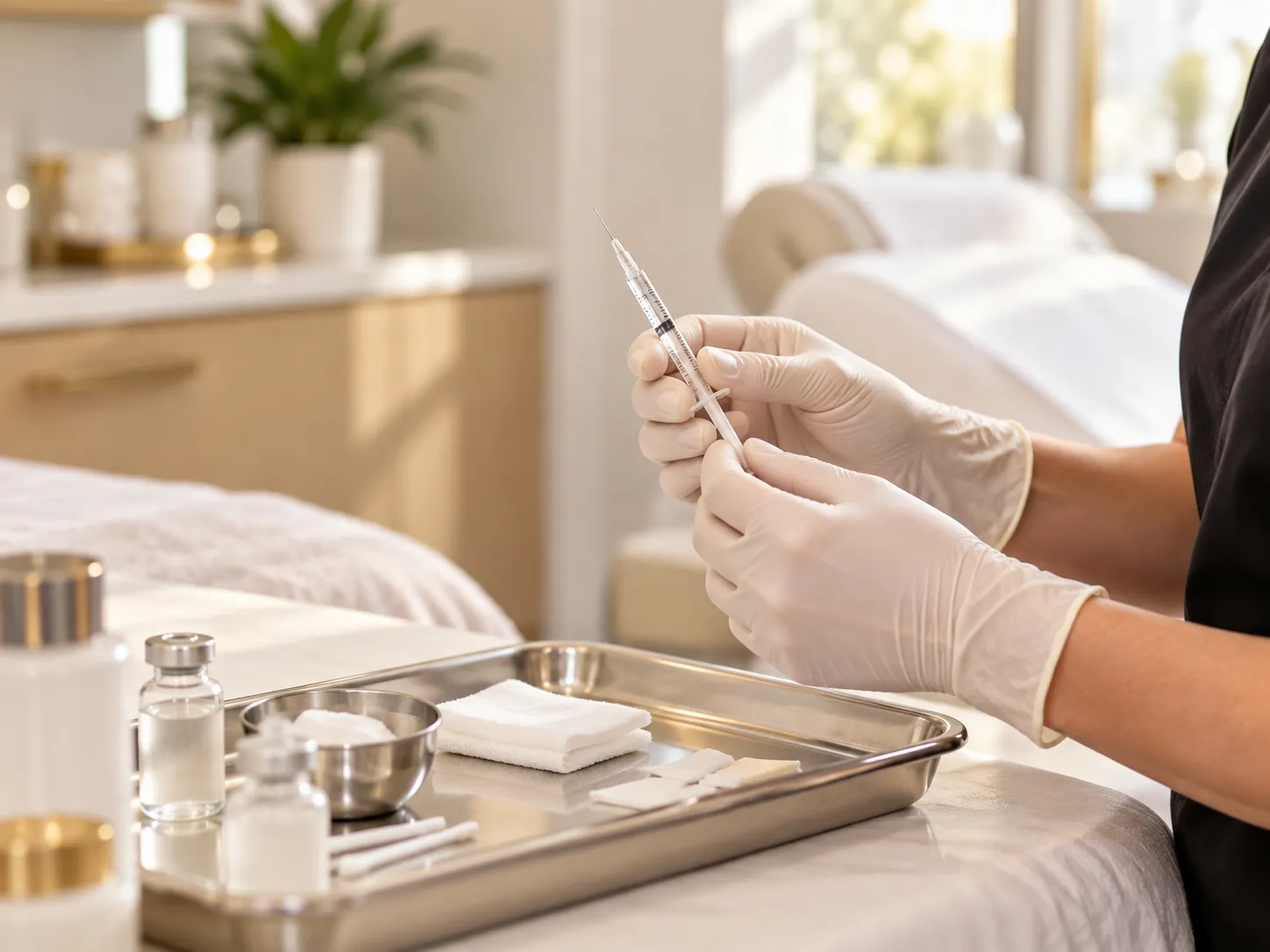
Injections: a series of small, shallow injections across the area. Underarms are generally well tolerated. Palms and soles are more sensitive, so numbing or other comfort measures are often used.
After: most people return to normal activity right away.
How quickly it works and how long it lasts
According to the International Hyperhidrosis Society's overview of Botox for hyperhidrosis, people usually start to notice results within a few days, with the full effect in about two weeks. The American Academy of Dermatology's hyperhidrosis treatment guide gives typical ranges of 3 to 10 months for underarms or hands, 3 to 6 months for feet, and about 4 1/2 months for the face.
Results vary from person to person. When sweating returns, the treatment can be repeated.
Possible side effects
Most side effects are mild and short-lived, such as tenderness or bruising at the injection sites. When the palms are treated, some people notice temporary weakness in hand grip, which is one reason technique and dosing matter. Your provider will review the risks that apply to the area you are treating and your health history.
Other treatment options
Botox is not the only option, and it is not always the first. At Gold Skin Care Center, treatment for hyperhidrosis may include:
Prescription-strength antiperspirants containing aluminum chloride, often the first step, applied at night.
Prescription topical medications, such as medicated wipes or gels for the underarms (several are FDA-approved; the AAD guide describes them).
Oral medication such as glycopyrrolate for more widespread sweating, used with monitoring for side effects like dry mouth.
miraDry® for the underarms, which uses controlled heat to destroy sweat and odor glands. It is designed as a long-term option, involves some temporary swelling and tenderness, and is generally not covered by insurance. See our sweat reduction page.
The right choice depends on where you sweat, how severe it is, what you have tried, and whether you prefer a repeat treatment or a longer-term one.
Is Botox for sweating covered by insurance?
Because hyperhidrosis is a medical condition, insurance may cover Botox for severe underarm sweating. Plans commonly require documentation that you tried prescription topical treatments first, and many require prior authorization. Coverage for palms, feet, or face varies more. Our team can help with the paperwork, and our guide to how insurance works for dermatology explains the basics. The International Hyperhidrosis Society also offers insurance resources on SweatHelp.org.
Why see a dermatologist for sweating
Hyperhidrosis treatment starts with the right diagnosis, including ruling out a secondary cause. At Gold Skin Care Center, care is led by board-certified dermatologist Dr. Michael H. Gold, and we offer the full range of options in one place, from prescription treatments to cosmetic neuromodulators and miraDry. Our affiliated Tennessee Clinical Research Center has also conducted studies in hyperhidrosis, so our team follows how new treatments are evaluated.
What to do next
Notice where and when you sweat most, and what you have tried so far.
Bring that history to your appointment, along with your insurance card.
Call (615) 383-2400 or use our scheduling form.
Frequently asked questions
Is Botox for sweating the same as Botox for wrinkles? It is the same type of medication, used at a different dose and placed in a different area. The FDA approval for underarm sweating belongs to Botox (onabotulinumtoxinA), while Botox® Cosmetic is the version approved for certain facial lines.
Does stopping underarm sweat cause you to sweat more elsewhere? Treating the underarms affects only a small area. It does not stop your body from cooling itself.
Can teenagers get Botox for sweating? The FDA approval for underarm sweating is for adults. Teens with hyperhidrosis have other options, and a dermatology provider can discuss what is appropriate.
How long does the treatment take? The injections themselves are usually quick. Plan for extra time at your first visit for evaluation.
This article is for general education and is not medical advice. Results vary, and every treatment carries risks. An appointment with a board-certified dermatologist or qualified dermatology provider is the best way to learn which options are right for you.
About the author
Michael H. Gold, MD, FAAD, is a board-certified dermatologist and dermatologic surgeon and the founder and medical director of Gold Skin Care Center in Nashville, which he established in 1990. He also founded the Tennessee Clinical Research Center and holds appointments as Clinical Assistant Professor at Vanderbilt University School of Nursing and Adjunct Assistant Professor at Meharry Medical College School of Medicine. Read Dr. Gold's full bio.
